


About Me
My passion is telling real-life stories.
I have been a journalist since 2000, and since 2003 I have worked as a reporter for NDR television. I am particularly interested in stories about people who achieve extraordinary things, who have achieved them in the past, or whose lives are marked by hardship—people who must overcome exceptional challenges. What fascinates me about others are the ruptures and dissonances in their lives, and their ability to cope with them.
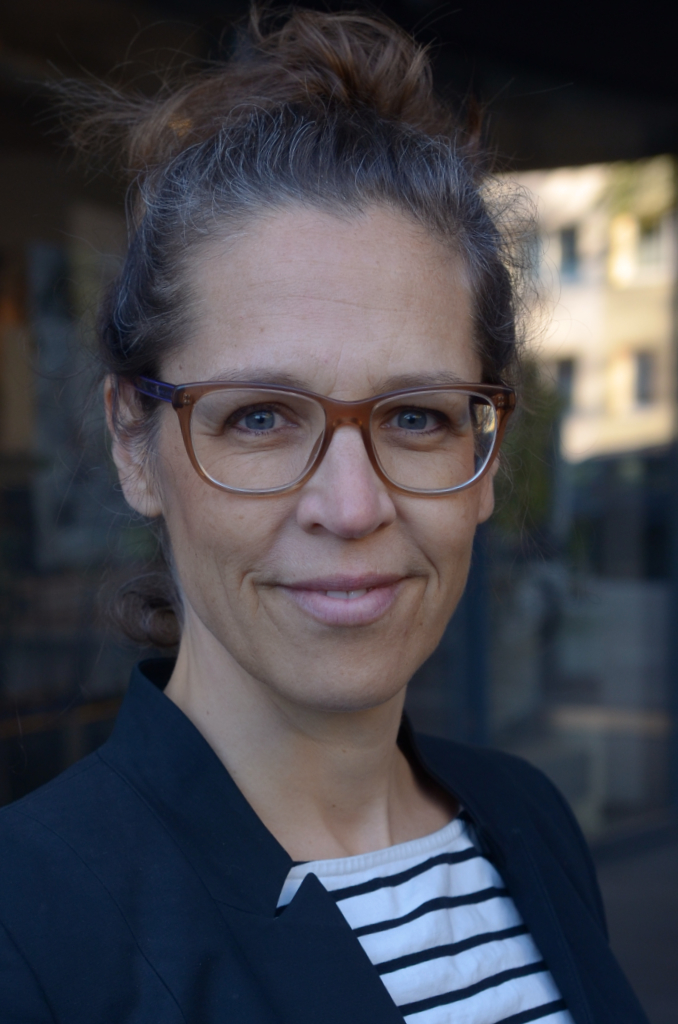
Corinna Below, photographed by © Patricia Batlle
National Socialism and Its Aftermath
One of my main areas of focus is National Socialism and its consequences for the victims. I am also interested in the stories of perpetrators. Equally compelling to me is the so-called “history after history,” meaning Germany’s postwar history, because it is closely connected to my own life. I repeatedly produce reports dealing with National Socialism and its legacy.
Remembering the Victims
For ARD/NDR, I covered the so-called Stutthof trial from September 30, 2021, to December 20, 2022, in Itzehoe. It was an incredibly intense and compelling time. Eight survivors testified as witnesses. They spoke about the horrific living conditions in the Stutthof concentration camp near Danzig—about arbitrariness, violence, hunger, disease, the deaths of their relatives, gassings, and the smell of burned bodies, as the crematorium operated around the clock.
A historian explained in detail how the camp was structured, making clear to what extent the former stenotypist Irmgard F. was complicit in more than 10,000 murders. The prosecutor ultimately called for a guilty verdict and requested a two-year suspended juvenile sentence. The defendant, now 97 years old, had been 18 and 19 at the time of the crimes (summer 1943 to the end of April 1945).
In the week before the verdict on December 20, I traveled to Vienna to interview one of the witnesses, Holocaust survivor Josef Salomonovic. It was a deeply intense and moving encounter. Now 84, he survived eight camps as a child. His father was murdered in Stutthof with a benzene injection. This interview resulted in four reports (including for ARD Tagesthemen).
I also reported on the day of the verdict. As expected, Irmgard F. was sentenced to a two-year suspended juvenile sentence. The verdict is not yet legally binding.
Facing the Past Remains Difficult
I also repeatedly report on how communities deal with the remembrance of Nazi crimes. The municipality of Mühbrook, for example, struggled for a long time to install a memorial plaque for two prisoners who were shot during a death march. In September, a local “biographies group” finally succeeded—though the plaque is very small. It shows that even today, many people find it difficult to confront the past openly and honestly.
At the unveiling, several children of survivors of the death march were present. It was deeply moving. Telling stories like this to a wider audience—and giving some of the victims of National Socialism a face and a name—is part of my mission.
The Case of Dr. Franz Lucas
On another occasion, I reported on a gynecologist from Elmshorn who practiced until the late 1980s, despite having been an SS doctor in Auschwitz and other concentration camps. There, he had taken part in sterilizations and selections on the ramp.
I was shocked. Was his past unknown in Elmshorn? How could women have trusted him? I spent weeks researching these questions. Today, the city archive shows my “NDR Zeitreise” to student groups, as it demonstrates the importance of archival research and uncovering the stories behind the stories.
The Biberstein Case
In 2014, I reported on an SS officer who later became a pastor in Kaltenkirchen: Ernst Biberstein. He had been involved in the shooting of Jews. Nevertheless, the local St. Michaelis church community struggled greatly with the idea of commemorating the victims—for example, by installing a memorial stone in the church garden.
Some people demanded it; others strongly opposed it. Addressing this conflict as a TV reporter means telling the story of how the legacy of National Socialism continues to shape society today.
In the end, the parish council agreed to a discreet plaque inside the church, with a vaguely worded text that does not mention Biberstein by name. For some, this was a scandal—far too little. For others, it was already too much. For me, it was an important story.
The Petersen Case
There is a painting titled “Burg zu Isenstein.” It needed restoration after having been stored for years in the attic of Elmshorn’s town hall. It was taken down in 1977, after the decision not to grant the painter Wilhelm Petersen honorary citizenship. By then, criticism of his role during the Nazi era had grown too loud.
The painting had once belonged to Hermann Göring and had hung in the council chamber since 1966 as a federal loan. Petersen had been highly respected—a brilliant illustrator, widely known for his “Mecki” comics in Hörzu, as well as for collectible images and commissioned portraits. He also designed the Flora fountain for the city; today only the figure remains, mounted on the façade of a bank, beneath a plaque reading: “Artist: Prof. Wilhelm Petersen.” He was never truly a professor—the title was awarded to him by Hitler.
To this day, the plaque remains without critical context. His past was not fully acknowledged until 1977. The head of the Industrial Museum, Bärbel Böhnke, later had the painting restored before it was loaned to the District Museum Wewelsburg (NRW), which dedicated an exhibition to Petersen in 2021.
The exhibition made one thing clear: Petersen was a gifted artist—but also a committed racist and antisemite, a favorite of Hitler, a friend of Göring and Rosenberg, a Nazi propaganda artist, an SS member, a near-honorary citizen in 1977, later a “Mecki” illustrator, and an unrepentant fascist who remained a member of the far-right NPD until his death in 1987.
The museum is also a memorial site specializing in perpetrator histories and is internationally recognized for its work. For an NDR “Zeitreise,” I set out to meet witnesses and experts who could help tell the story of this man—and of how he continued to be admired in postwar Germany.
Corinna Below